If you live west of the 5, you know the drill. The marine layer rolls in overnight, the driveway is damp by morning, and anything metal in the garage slowly rusts. Concrete feels it too. That humid air, plus the moisture moving up through the slab itself, is why some garage floor coatings in beach neighborhoods fail years before identical floors further inland.
That reality sits at the heart of the coastal polyaspartic vs epoxy question, and the honest answer has two parts. As the visible top layer of a beachside San Diego garage floor, polyaspartic usually wins: it will not yellow in UV light, and it cures reliably through the marine layer’s temperature and humidity swings. Epoxy still earns its keep as a base coat, a budget option, and a moisture-management layer, which is why many of the longest-lasting floors near the water use both.
The deciding factor is not the brochure, though. It is how much moisture your slab is pushing upward, which a professional measures rather than guesses. Nu Garage & Epoxy installs epoxy, polyaspartic, polyurea, and polyurethane concrete coating systems across San Diego County, from Coronado and La Jolla out to Poway and Rancho Bernardo, so this comparison reflects what actually holds up here rather than a generic pitch for the best coating San Diego shoppers see advertised nationally.
Not sure which side of the fence your garage falls on? Reach out to Nu Garage & Epoxy for a quote and get a straight recommendation for your address. It is an easy, no-pressure first step, and it turns coastal polyaspartic vs epoxy from a research project into a ten-minute conversation.
What Coastal Moisture Garage Floors Are Actually Fighting
Moisture attacks a floor coating from two directions. The first is the air. During May Gray and June Gloom, neighborhoods like Imperial Beach and Solana Beach can sit above 80 percent relative humidity for hours each morning. When concrete is cooler than the dew point, water condenses on it. Apply a coating over that damp surface and you have built a failure into the floor on day one. The air side of coastal polyaspartic vs epoxy is really a scheduling question.
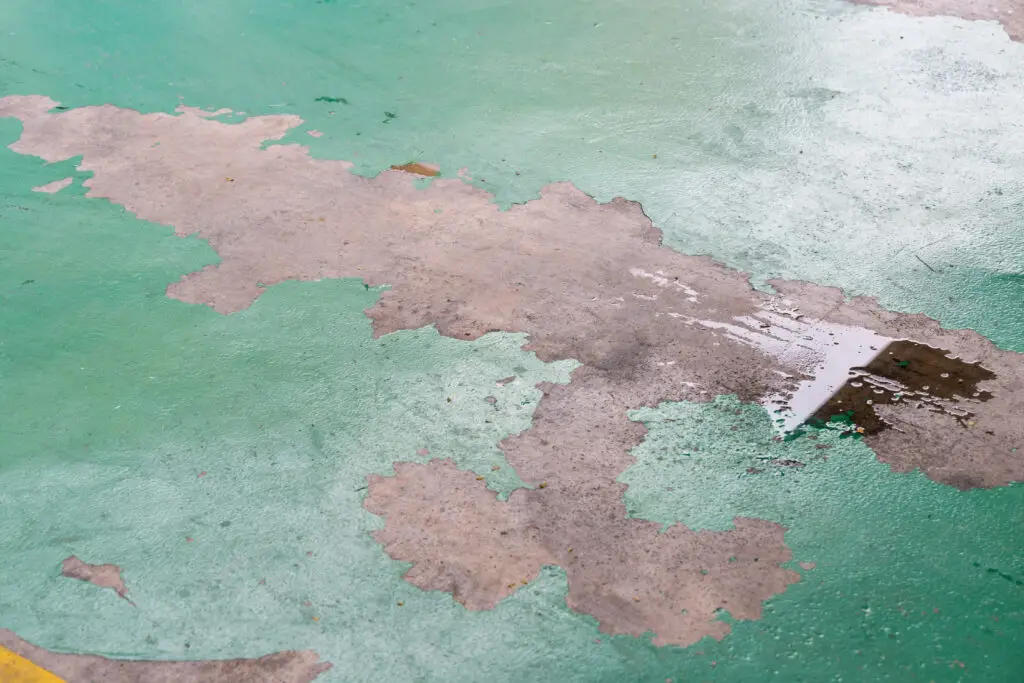
The second direction is up through the concrete. Soil under your slab holds water that constantly migrates upward as vapor, a process called moisture vapor transmission. Many older homes near the beach sit on slabs with thin vapor barriers or none at all, so the concrete breathes ground moisture around the clock. Trap that vapor under the wrong coating and pressure builds until the floor blisters, bubbles, or peels in sheets. White chalky efflorescence on bare concrete is the visible trail of a coastal moisture garage problem doing its slow work.
Both of those failure modes are why coastal polyaspartic vs epoxy is a different comparison here than it is in Phoenix or Denver. Inland, the question is mostly about wear and looks. Within a few miles of the water, it is about whether the coating survives the slab underneath it.
Test the Slab Before You Pick a Chemistry
Any honest coating recommendation starts with data. The industry standard is ASTM F2170, the Standard Test Method for Determining Relative Humidity in Concrete Floor Slabs Using in situ Probes, which reads the humidity inside the slab through probes placed in drilled holes. The test itself does not declare a pass or fail number. The threshold comes from whoever makes the coating, and resinous systems commonly cap out somewhere in the 75 to 80 percent range, with higher readings calling for a moisture-mitigating primer or a different system entirely. Instrument makers publish plain-language explainers, like this guide to ASTM F2170 testing, if you want to know what your installer should be checking before the coastal polyaspartic vs epoxy conversation even starts.
Preparation matters just as much. Nu Garage & Epoxy diamond grinds the concrete to the national standard specification of CSP 3 to 5 required for epoxy and polyaspartic coatings, rather than acid etching. That mechanical grind opens the concrete so the primer can key in deeply, your best defense against vapor pressure pushing the coating off from below. No coastal polyaspartic vs epoxy recommendation means much without that profile underneath it. Their common questions page covers the prep process in more detail, and their post on why DIY epoxy kits peel shows what happens when that step gets skipped.
How San Diego Humidity Treats Epoxy
Choosing a San Diego humidity coating starts with cure chemistry. Epoxy is a two-part resin, and the amine hardeners in many epoxies react with moisture and carbon dioxide in damp air, forming a waxy film called amine blush. On a foggy coastal morning, curing epoxy can blush without anyone noticing, leaving a cloudy or greasy-feeling finish. If another coat goes over the blush without proper removal, the layers can separate later. That single failure mode is the most common reason coastal polyaspartic vs epoxy tilts away from epoxy as a finish layer.
Cool, damp conditions also stretch epoxy cure times. A floor ready for foot traffic overnight in Escondido might need noticeably longer in Del Mar, and Nu Garage asks customers to wait 48 hours before driving on a fresh floor, with 72 hours after the last coat as the safer number. Then there is sunlight. Standard epoxies are aromatic chemistries, so UV exposure gradually turns them amber. A south-facing garage that catches direct sun through open doors can visibly yellow within a few years.
None of that makes epoxy a bad product. It builds a thick, hard, self-leveling layer, bridges minor imperfections, costs meaningfully less per square foot, and moisture-tolerant epoxy primers are among the best tools available for sealing a damp slab. The catch is that in beach-adjacent humidity, epoxy demands careful timing, dew point monitoring, and a UV-stable topcoat, which is exactly where coastal polyaspartic vs epoxy usually resolves into a hybrid build.
How Polyaspartic Handles the Same Conditions
Polyaspartic is an aliphatic polyurea chemistry, and that one word, aliphatic, is why it will not yellow. UV stability is built into the resin, not added on, and that is the plainest advantage anyone can point to in coastal polyaspartic vs epoxy. That alone makes it the better finish layer near the beach, and it is a large part of why Nu Garage backs its installs against yellowing and ambering at all.
Polyaspartics also cure fast across a wide temperature range, a real advantage when the marine layer drops slab temperatures into the 50s overnight even in summer. Fast cure is why 95 percent of Nu Garage’s residential installs finish in a single day, and it shrinks the window during which fog or condensation can interfere. Speed cuts both ways, though. A quick-setting product leaves little working time, so it is unforgiving in DIY hands, and very humid air shortens that window further. Polyaspartic goes down in thinner coats than a flooded epoxy body coat and typically costs more per square foot. On a slab with high vapor readings, manufacturers still want a dedicated primer underneath rather than polyaspartic bonded straight to damp concrete. Even on the winning side of coastal polyaspartic vs epoxy, the slab test comes first.
The Coastal Polyaspartic vs Epoxy Scorecard
Run the coastal polyaspartic vs epoxy comparison honestly and each chemistry has a clear lane.
Epoxy wins when the budget is tight, when the slab needs thick build to hide repairs, and when moisture readings call for a mitigating epoxy primer as the foundation of the system. It is also a fine choice further inland. In Poway, Rancho Bernardo, and Santee, where the marine layer burns off early and garages run drier, a quality epoxy system with a protective topcoat performs well for years, and coastal polyaspartic vs epoxy gets a lot less lopsided the farther east you go.
Polyaspartic wins on the coast. For garages in La Jolla, Carmel Valley, Encinitas, and Coronado, its UV stability, humidity-tolerant cure, and one-day turnaround make it the stronger finish. It is also the pick when you cannot leave cars in the driveway for three days while epoxy hardens, which is often what settles coastal polyaspartic vs epoxy for a busy household.
The best answer for many homes is not either-or. A hybrid system pairs an epoxy or moisture-tolerant primer that seals the slab with a polyaspartic topcoat that shrugs off sun and fog. That layered build is frequently the best coating San Diego homeowners near the water can buy, because each chemistry does the job it is genuinely best at. Expect polyaspartic-topped systems to cost more than basic epoxy, and treat any bid dramatically below the local market as a sign that prep or materials are being cut. Nu Garage & Epoxy offers 10 year and lifetime material and labor warranties covering bubbling, peeling, yellowing, and hot tire pickup, and their list of questions to ask any contractor is a useful filter before you sign anything.
Common Questions About Coastal Polyaspartic vs Epoxy
Coastal polyaspartic vs epoxy questions come up in nearly every consultation we have within sight of the water.
Can a garage floor be coated during May Gray or June Gloom?
Yes, with planning. Installers track the dew point and slab temperature and schedule coating for the window when condensation risk is lowest. A San Diego humidity coating usually succeeds or fails on whether the installer respects those numbers, not on which product came off the truck.
Will my floor yellow if I live near the beach?
A standard epoxy left as the finish layer eventually will. A polyaspartic finish will not, which is the single clearest verdict in the whole coastal polyaspartic vs epoxy debate and why UV-stable topcoats are standard practice in coastal work.
How do I know if my slab has a moisture problem?
Watch for white powdery efflorescence, damp patches that come and go, or musty odors. The only reliable confirmation is testing, worth doing before any money goes into coatings, because a coastal moisture garage problem always starts below the surface. Badly spalled or pitted concrete may need restoration before any coating goes down.
Is the coastal answer different from the inland answer?
Yes, and that is the whole point of running coastal polyaspartic vs epoxy as its own comparison. A few miles east, drier slabs and hotter garages change the math, and epoxy systems that would be a poor bet in Imperial Beach hold up fine in East County.
Get a Floor Built for Your Side of San Diego
The coastal polyaspartic vs epoxy debate is not really about which product is better. It is about matching chemistry to conditions: your slab’s moisture readings, your garage’s sun exposure, and how quickly you need the space back. There is no single best coating San Diego wide, only the right San Diego humidity coating for your address, and a shop that installs both chemistries, tests before recommending, and grinds every floor to spec will steer you right.
Nu Garage & Epoxy has coated garages across the county’s microclimates, and you can see the range in their gallery. Contact the team or call 619-537-8837 to talk through coastal polyaspartic vs epoxy for your garage, and get a floor that treats the marine layer as a design constraint instead of a surprise.
WRITTEN BY
Nathan Obermeyer
Nathan Obermeyer is the founder and owner of Nu Garage & Epoxy, a San Diego company that has been transforming garages since the mid-2000s. Nathan started out installing garage ceiling racks while working full-time and going to school, then expanded into epoxy flooring, building one of San Diego’s first garage specialty companies. Today his team installs epoxy, polyaspartic, and polyurea concrete coatings for garages, pool decks, driveways, patios, and commercial spaces, along with cabinets, shelving, and other garage organization systems, all backed by a lifetime adhesion warranty. As a veteran and first responder owned business, Nu Garage puts service first, and Nathan says his number one goal is simply to be helpful. Outside of work, he volunteers with Habitat for Humanity and trains in Brazilian Jiu-Jitsu.