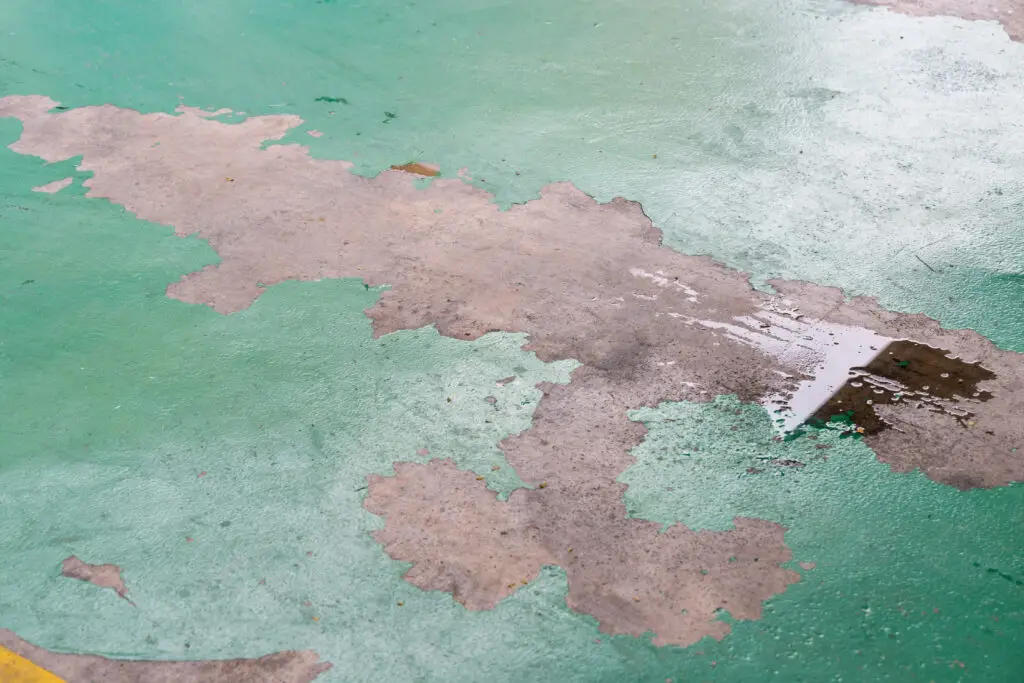
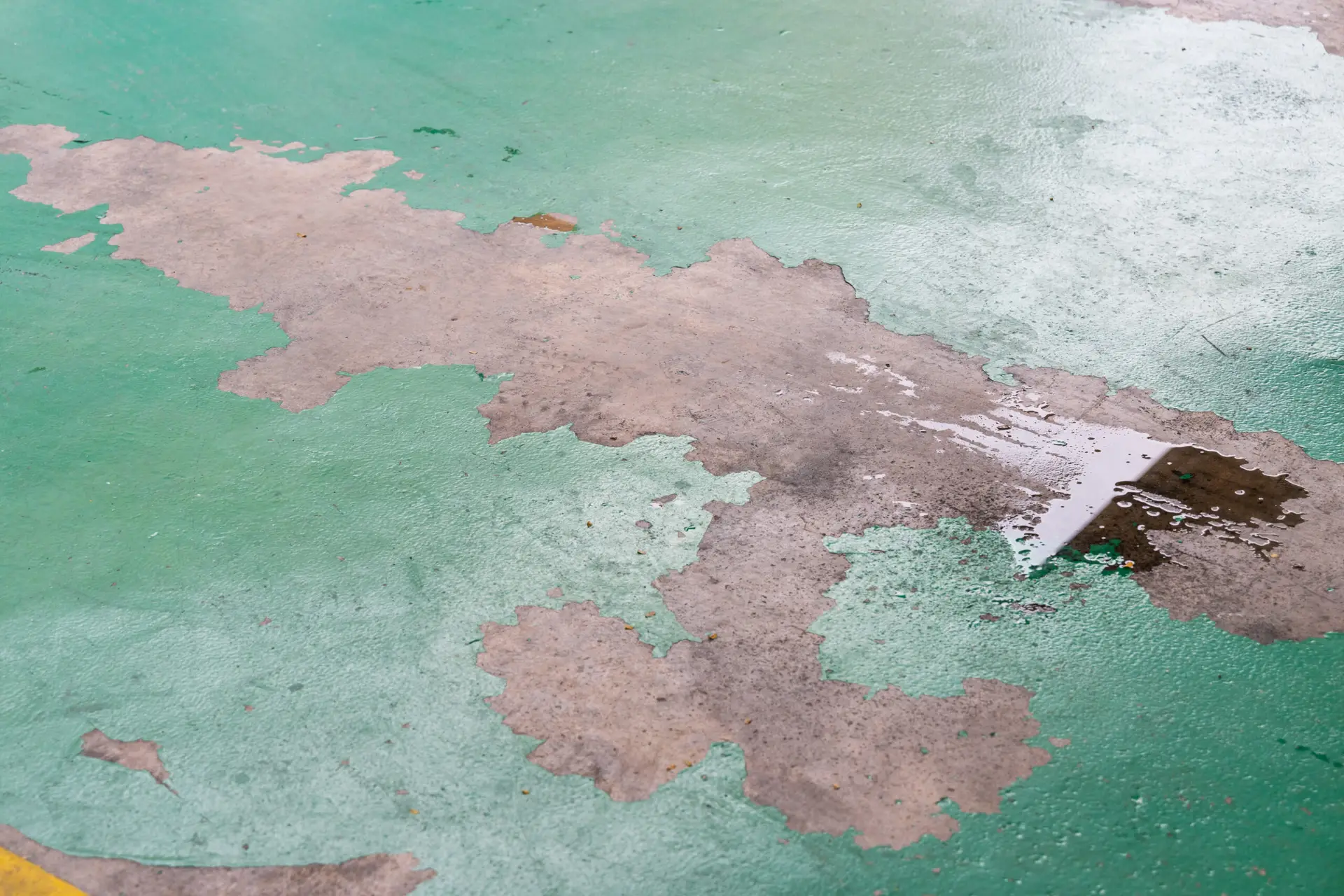
Peeling is one of the most common problems associated with retail epoxy floor kits. In many cases, the coating initially appears successful but begins lifting beneath parked vehicles after repeated exposure to heat and tire pressure. Homeowners searching for a DIY epoxy peeling fix often notice bare concrete along the tire paths, loose flakes on the floor, or pieces of coating attached to their tires. These problems can develop more quickly in East County, where high summer temperatures place additional stress on a garage coating.
A lasting repair must address the loss of adhesion between the epoxy and the concrete. Applying fresh epoxy over peeling areas does not restore that bond because the remaining coating may also be poorly attached. The more dependable solution is to remove the failed material, mechanically profile the slab, repair surface defects, and apply a coating system suited to vehicle traffic and elevated temperatures.
Several factors determine how well a floor holds up, including concrete preparation, coating thickness, moisture levels, and resistance to hot tires. These differences are central to any professional vs DIY epoxy comparison. The sections below explain the causes of peeling, the conditions behind hot tire pickup San Diego homeowners frequently experience, and the diy epoxy peeling fix repair methods that offer better long-term performance. Nu Garage & Epoxy can also evaluate the existing floor and recommend suitable options by text or through the company’s contact form.
What Is Hot Tire Pickup and Why Does It Ruin Garage Floors?
Hot tire pickup is the industry’s name for the flakes of flooring that break off of the surface and stick to your tires. After a drive on warm pavement, tire surface temperatures can climb well past 100 degrees. You park, the hot rubber sits on the coating, and the heat softens the film. As the tire cools overnight, it contracts, grips the softened coating, and slowly pulls it free of the concrete.
The hot tire pickup San Diego homeowners run into is almost always tied to two primary weaknesses. First, budget kits are mostly water-based epoxy paint with a low percentage of actual epoxy solids, so the cured film is thin and re-softens at temperatures common to summer tires. Second, improper preparation of the surface leaves the original bond weak in the first place, even before any heat damage. Heat exposes both problems at the same spot: right under your tires.
Why DIY Kits Peel Faster in East County Heat
Coastal garages get a break from the ocean breeze. Garages in El Cajon, Santee, Lakeside, La Mesa, and Spring Valley do not. East County’s inland valleys routinely run hotter than the coast in summer, and you can see that split for yourself in the National Weather Service climate data for the San Diego region. A car that just climbed I-8 in August is parking on tires that are dramatically hotter than anything a coastal garage sees, inside a garage that may have been baking all afternoon.
High temperatures can expose weaknesses in a DIY epoxy installation. Many retail kits recommend mild acid etching, which may create limited surface texture without fully removing the dense upper layer of the concrete. As a result, the epoxy may remain near the surface rather than forming a strong mechanical bond with the open pores of the slab.
Moisture vapor, insufficient profiling, and the absence of a compatible primer can further reduce adhesion. When combined with a thin coating layer, these conditions increase the risk of peeling and delamination. A durable East County garage coating requires thorough surface preparation and materials formulated for the region’s high garage temperatures.
The Real DIY Epoxy Peeling Fix: Repair or Start Over?
It’s tempting to scrape the loose spots, sand the edges, and roll fresh epoxy over the whole floor. The problem is that peeling is a symptom of a failed bond, not a surface blemish. The areas that look fine today are usually holding on as loosely as the spots that already let go. New epoxy bonds to the old coating, and the old coating will continue to break away from the concrete underneath. The new layer peels in sheets that are simply thicker than before.
A true DIY epoxy peeling fix means treating the whole system, and that starts with removal.
Professionals grind the entire floor with diamond tooling, which strips the failed coating and the upper layer of concrete that should’ve been removed before installation. Quality installers prep to a defined concrete surface profile, the roughness standard published by the International Concrete Repair Institute. Nu Garage & Epoxy grinds every slab to a CSP 3 to 5 profile, repairs cracks and damaged sections, and only then installs coating. That texture is what lets a coating anchor into the slab.
Could you rent a grinder and attempt this yourself? Technically yes, but rental grinders are underpowered for coating removal, and a second failed attempt costs more than doing it correctly once. This is the point where most homeowners weigh professional vs DIY epoxy and decide their weekend is worth more than the savings and risk of a failed install. The right DIY epoxy peeling fix is one you only pay for once.
Professional vs DIY Epoxy: What the Pros Do Differently
Beyond the diamond grinding, professional installers use high-build, 100 percent solids epoxy and polyaspartic products instead of the diluted resins in retail kits. The cured film is many times thicker, and polyaspartic topcoats are UV stable, meaning they won’t yellow in sunlight. Those materials maintain their grip and hardness at tire temperatures that damage weaker epoxy. For homeowners researching a DIY epoxy peeling fix, these material differences help explain why another retail coating may lead to the same problem. That’s the difference between an East County garage coating built for August heat and a product engineered for a price point.
The process is also faster than most people expect. Nu Garage & Epoxy completes about 95 percent of residential floors in a single day, then asks you to keep vehicles off the surface for 72 hours after the final coat so it reaches full strength before your tires test it.
Then there’s accountability. A DIY kit’s warranty covers the product in the can, not the floor it becomes. A professional installer stands behind the finished result. Nu Garage & Epoxy backs its installs with a lifetime adhesion warranty that covers peeling and hot tire pickup. We’re confident in our products and the system’s ability to withstand heat and weight. In the professional vs DIY epoxy comparison, that warranty is the part no DIY kit can match.
Frequently Asked Questions
Can I just recoat over my peeling epoxy?
No, not if you want it to last. New coatings bond to the old film, and the old film is already releasing from the concrete. Full removal by grinding, followed by proper surface profiling, is the only DIY epoxy peeling fix that addresses the failed bond instead of hiding it.
How long does a professional garage floor installation take?
Most residential installs are finished in one day, with two days reserved for floors that need extra crack repair or moisture mitigation. Plan on parking outside for about three days after the last coat, since coatings need roughly 72 hours before vehicle traffic.
Will a professional coating stop hot tire pickup for good?
A properly ground, high-solids system with a polyaspartic topcoat won’t soften and release under hot tires the way kit epoxy does. For homeowners considering a DIY epoxy peeling fix, replacing the failed material with a professionally installed system provides a more durable, long-term solution. That’s why the hot tire pickup that San Diego drivers battle every summer is specifically covered under Nu Garage & Epoxy’s adhesion warranty, along with peeling, bubbling, and yellowing. You can read more answers on their common questions page.
Ready for a Floor That Stays Put?
Nu Garage & Epoxy is a veteran-owned, father-and-son garage floor coating company that has served San Diego since 2005, including El Cajon, Santee, Lakeside, La Mesa, and Spring Valley. We’re licensed (#1029937), insured, and we’ve built our reputation on floors that survive exactly the conditions that kill DIY kits. If your floor is flaking, or you’d rather never find out what an East County garage coating failure looks like, reach out to the team and get a floor built for local heat from the start.
WRITTEN BY
Nathan Obermeyer
Nathan Obermeyer is the founder and owner of Nu Garage & Epoxy, a San Diego company that has been transforming garages since the mid-2000s. Nathan started out installing garage ceiling racks while working full-time and going to school, then expanded into epoxy flooring, building one of San Diego’s first garage specialty companies. Today his team installs epoxy, polyaspartic, and polyurea concrete coatings for garages, pool decks, driveways, patios, and commercial spaces, along with cabinets, shelving, and other garage organization systems, all backed by a lifetime adhesion warranty. As a veteran and first responder owned business, Nu Garage puts service first, and Nathan says his number one goal is simply to be helpful. Outside of work, he volunteers with Habitat for Humanity and trains in Brazilian Jiu-Jitsu.